
Pallets may not look like the most exciting part of a supply chain, yet they quietly support almost every product that moves through global commerce. When these wooden or plastic platforms go missing or sit idle in the wrong place, the ripple effect touches transportation costs, inventory planning, and even customer commitments. Modern pallet tracking is changing how companies understand the flow of goods, replacing guesswork with data that can be acted on instantly. As connected trackers, location technologies, and cloud platforms become more accessible, tracking a pallet is a practical step toward visibility and resilience.
Understanding Pallet Tracking
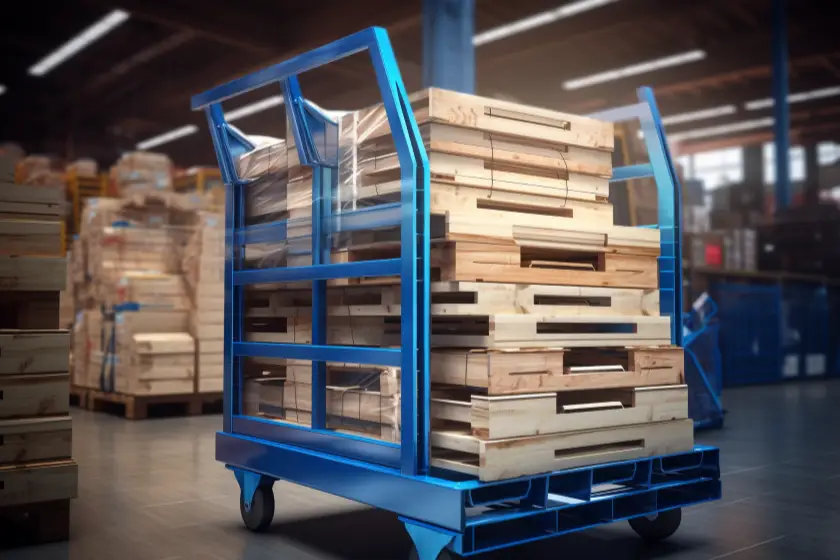
Pallet tracking refers to the practice of attaching identifiers or trackers to pallets so their location and status can be monitored as they move through warehouses, yards, and the wider logistics network. A pallet tracker can capture movement events as well as entry and exit from certain areas. For operators, this turns a historically opaque asset into a data point that speaks for itself.
By linking pallets to digital records in real time, organizations improve utilization, avoid unexpected shortages, and gain clarity about transit conditions. Instead of searching for lost items or waiting for manual updates, teams see what is happening as it unfolds. As a result, pallet tracking brings more control over everyday operations that were once difficult to measure.
Challenges Around Pallets
Pallet: Losses, Theft, and Damage
It is common for pallets to disappear during busy loading cycles or multi-stop transportation routes. They may be misplaced, taken by mistake, or intentionally removed from circulation. Many businesses write these losses off as normal, but the cumulative cost can be substantial. Damage also occurs without clear visibility into when or how it happened, making it harder to intervene early or adjust handling processes.
Supply and Demand: Availability and Capacity
Pallet pools often fluctuate because of seasonal demand or unexpected spikes in shipments. When operators cannot see how many pallets are truly available, they risk over-ordering, under-ordering, or leaving assets unused in remote corners of their network. Limited visibility also slows down cycle time, as pallets may sit idle at one location while another location faces a shortage. The challenge is not only about having enough pallets, but also knowing where they are and how efficiently they rotate.
What You Can Gain from Pallet Tracking
Indoor Visibility and Transit Tracking
Modern pallet tracking technologies work inside warehouses, across yards, and on the road. Indoor positioning reduces the hours spent searching for stray pallets, while outdoor tracking helps teams follow assets during transit. By combining the two, companies gain a more complete picture of each pallet’s journey, closing visibility gaps that traditionally caused delays or confusion.
Operational Efficiency
When pallet movement becomes measurable, workflows improve. Teams can organize staging areas more effectively, reduce double-handling, and plan replenishments with better accuracy. Automated status updates replace manual scanning or paperwork, allowing staff to focus on higher-value tasks. This shift improves throughput and reduces unnecessary dwell time.
Loss Reduction and Improved Security
A pallet tracker adds accountability to every handoff. When an asset enters an unauthorized area, the system can trigger alerts. This helps prevent theft and recover items before they disappear completely. Impact detection and movement-based reporting also shed light on potential damage events, creating opportunities for proactive intervention.
Inventory Management Optimization
Tracking pallets often leads to better inventory accuracy because the platform that carries a product becomes part of the digital record. Companies can align pallet data with inventory workflows, ensuring that inbound and outbound counts reflect real conditions. This results in smoother planning, clearer forecasting, and fewer stock discrepancies.
Pallet Tracking Technologies You Should Know
Barcodes
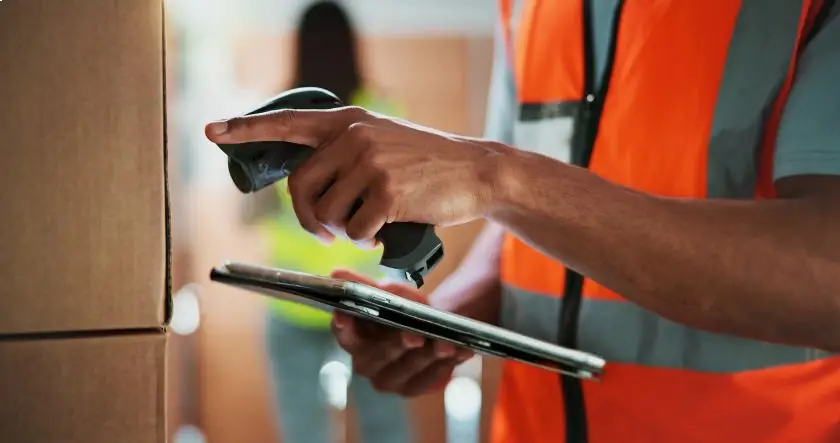
Barcodes are the simplest form of pallet tracking. They require manual scanning through handheld devices or fixed readers. While cost-effective, they rely heavily on worker compliance and do not provide real-time visibility. Barcodes are most useful in controlled indoor environments where process discipline is consistent.
Bluetooth
Bluetooth Low Energy (BLE) is widely adopted for pallet tracking because it balances cost, power consumption, and accuracy. BLE tags broadcast signals that can be detected by gateways or smartphones. Indoors, BLE can deliver room-level or zone-level awareness. When paired with mobile networks or mesh systems, it also supports outdoor insight. BLE’s flexibility makes it suitable for high-volume pallet fleets where battery longevity matters.
RFID
Radio frequency identification uses tags that can be read without direct line-of-sight. Passive RFID tags are lightweight and inexpensive, making them common in warehouses with fixed scanning points. Active RFID tags include batteries for longer range. RFID is effective for high-speed environments such as dock doors or automated sorting lines, but infrastructure requirements can limit broad deployment across diverse locations.
GPS
GPS-based pallet tracking provides location data during transportation, especially across long distances. It is ideal for high-value goods or extended supply chains where knowing the pallet’s position at any moment is crucial. Although GPS alone does not work well indoors, it can be combined with BLE, cellular, or other techniques to offer hybrid visibility. As battery efficiency improves, GPS-enabled devices become more practical for pallet applications.
Unlock Efficiency: How Minew Transforms Pallet Tracking
MTB07 Bluetooth Pallet Tracker
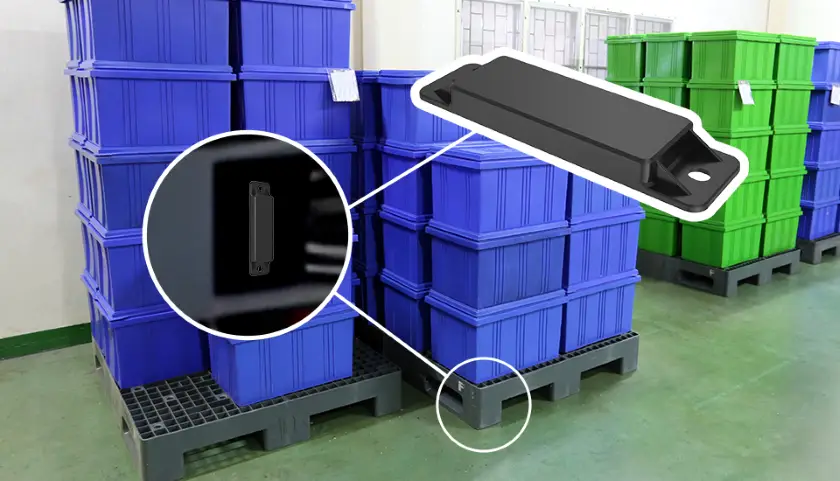
The MTB07 is designed for high-volume pallet tracking in warehouses and distribution centers. It uses Bluetooth to provide reliable location updates, while its long-life battery and rugged, IP67 / IK08-rated housing keep it running under heavy handling. Optional motion sensing and simple magnetic activation make it easy to deploy at scale, turning pallets into stable, low-maintenance data points for your tracking system.
E9 Waterproof Beacon
The E9 Waterproof Beacon is a compact, screw-mounted Bluetooth device built for demanding use cases such as smart warehouses and cold-chain monitoring. Its low-energy design supports long-term asset tracking, and Wirepas Mesh compatibility enables coverage across larger facilities or retail and public spaces where proximity-based services are needed. Durable and simple to install, it helps extend pallet and asset visibility without complicating operations.
Conclusion
Pallet tracking has become an essential part of modern logistics. By improving visibility, reducing losses, and streamlining operations, it helps companies manage pallets with the same precision they expect from digital systems. Technologies like BLE, RFID, GPS, and barcodes all offer different strengths, and when combined with intelligent hardware, they unlock new levels of efficiency.
Solutions such as the MTB07 pallet tracker and E9 Waterproof Beacon demonstrate how advanced trackers can transform everyday assets into connected components of a smarter supply chain. As businesses continue to adapt to rising demand and tighter delivery expectations, pallet tracking provides a practical path toward resilience, clarity, and data-driven performance.
 Chat now